Introduction
The Aged Care Act 2025 represents a significant shift in how aged care providers in Australia are expected to demonstrate compliance. Regulatory scrutiny is increasing, and the focus is moving beyond policy documentation toward evidence of operational capability.
For boards and executive teams, this shift has direct implications for how operational systems are governed. Compliance is no longer satisfied by written policies alone. Regulators are increasingly interested in whether an organisation's systems can support evidence-based decision making, maintain traceability across care and administrative functions, and produce reliable reporting on demand.
Operational systems — the platforms that manage enquiries, admissions, care planning, incident recording and financial reconciliation — are becoming a governance concern. Where these systems fall short, the organisation's ability to demonstrate compliance under audit is weakened, regardless of the quality of its care delivery.
This guide is intended for aged care executives and board members who are assessing their organisation's readiness for the regulatory environment emerging under the new Act.
Why operational systems matter under the new Act
Under the Aged Care Act 2025, the relationship between operational systems and regulatory compliance is more direct than it has been historically. Systems are no longer simply administrative tools. They form part of the evidence base that regulators will assess.
Operational systems affect an organisation's capacity across several areas that carry regulatory weight:
- Audit readiness. When regulators or quality assessors request evidence, the speed and reliability of the response depends on whether information is structured, accessible and verifiable within the system. Organisations that rely on manual compilation are slower to respond and more likely to present incomplete or inconsistent records.
- Regulatory reporting. The new Act is expected to increase both the frequency and granularity of reporting requirements. Systems that cannot generate structured reports aligned with regulatory formats create ongoing operational burden and increase the risk of reporting errors.
- Incident traceability. The ability to trace an incident from initial recording through investigation, response and resolution — with clear timestamps and responsible parties — is a fundamental compliance expectation. Systems that fragment this trail across multiple platforms or manual processes introduce risk.
- Care documentation. Care plans, assessments and progress notes must be contemporaneous, linked and retrievable. Systems that store documentation in unstructured formats or across disconnected repositories make it difficult to demonstrate continuity of care.
- Financial transparency. Aged care funding arrangements require clear alignment between the care delivered and the funding claimed. Systems that separate clinical and financial records create reconciliation challenges that carry both compliance and financial risk.
The governance risk is straightforward: if operational systems cannot support these functions reliably, the organisation's compliance posture is structurally weakened — regardless of the intentions or competence of its staff.
Where providers are currently exposed
Many aged care providers operate with system arrangements that were established under previous regulatory frameworks. These arrangements may have been adequate at the time, but the expectations of the Aged Care Act 2025 require a higher standard of system capability.
Common patterns across the sector include:
- Fragmented systems. Enquiry management, admissions, care planning, incident management and financial administration are handled across separate platforms that do not share data. Staff navigate between systems, and no single view of a resident's or client's journey exists.
- Manual reconciliation. Data is extracted from one system, reformatted, and entered into another. Reporting requires manual aggregation from multiple sources. Each manual step introduces delay and the potential for error.
- Email-based intake. Enquiries and referrals arrive via email and are tracked informally. There is no structured record of response times, follow-up actions or conversion outcomes. This creates a gap in both operational visibility and compliance evidence.
- Duplicated data entry. The same information — resident details, assessment data, contact records — is entered into multiple systems because those systems are not integrated. This wastes staff time and creates data consistency risks.
- PDF-based workflows. Forms, assessments and care plans are completed as PDF documents and stored in file systems or email archives. These documents are difficult to search, aggregate or report against, and they sit outside the structured data environment that regulators expect.
- Lack of audit trails. Changes to records, care plans or financial entries are not logged with sufficient detail. It is not possible to determine who made a change, when it was made, or what the previous value was. This absence undermines the organisation's ability to demonstrate accountability.
These patterns are widespread and are rarely the result of negligence. They typically emerge over time as organisations add systems incrementally, respond to immediate operational needs, or work within the constraints of legacy platforms. However, under the Aged Care Act 2025, these arrangements represent measurable compliance exposure.
Governance questions boards should be asking
Boards have a responsibility to understand whether their organisation's operational systems are fit for purpose under the current and emerging regulatory environment. The following questions are intended to support that assessment:
- Can our systems demonstrate regulatory compliance if we are audited tomorrow? Is the evidence structured, accessible and verifiable — or would it need to be manually compiled?
- Do we have reliable, system-level audit trails that record who changed what, when and why across our core operational processes?
- Can we trace decisions, care documentation and incident responses over time through a connected system record — or are these records distributed across platforms, emails and documents?
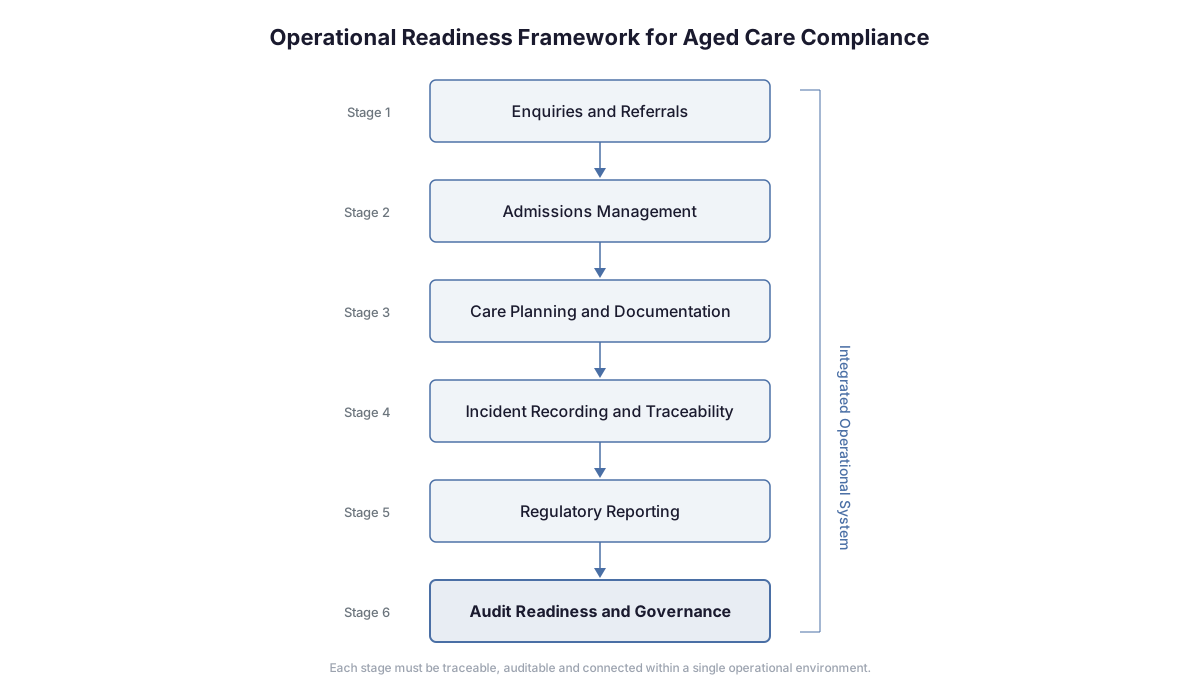
- Are our admissions, care planning, incident management and reporting functions aligned within a single operational environment, or do they operate independently?
- Can our systems support the regulatory reporting requirements that are anticipated under the Aged Care Act 2025, including any increase in reporting frequency or granularity?
- What is the operational and compliance cost of our current system fragmentation — in staff time, error rates and audit preparation effort?
- If a critical system failed or a vendor ceased support, do we have continuity arrangements that protect our compliance obligations?
- When was the last independent assessment of our operational systems against current regulatory expectations — as distinct from their operational functionality?
These questions are not intended to create alarm. They are the kind of questions that well-governed organisations routinely ask as part of their risk oversight responsibilities.
What operational readiness actually looks like
Operational readiness, in the context of the Aged Care Act 2025, refers to an organisation's capacity to meet its regulatory obligations through the normal functioning of its operational systems — without relying on manual workarounds, ad hoc compilation or individual staff knowledge.
Organisations that have achieved a mature level of operational readiness typically share several characteristics:
- Integrated workflows. Core functions — from initial enquiry through admissions, care delivery, incident management and reporting — are connected within a single operational platform or through well-governed integrations. Information flows between functions without manual re-entry.
- Compliance-aware system design. The system is configured to reflect regulatory requirements, not just operational convenience. Data structures, workflow stages and reporting outputs are aligned with what regulators expect to see, reducing the gap between how the organisation operates and how it demonstrates compliance.
- Comprehensive audit logging. All significant actions within the system — record creation, modification, status changes, approvals — are logged with timestamps and user attribution. This audit trail is immutable and accessible for review without requiring technical intervention.
- Reporting alignment. The system can generate reports that correspond to regulatory reporting requirements directly from operational data. Reporting is a function of normal system use, not a separate exercise that requires data extraction and manual formatting.
- Governance visibility. Boards and executives have access to system-level indicators of operational and compliance performance. They can see, at an appropriate level of abstraction, whether key processes are functioning as expected and where risks may be emerging.
Achieving this level of readiness is not a technology project alone. It requires alignment between governance expectations, operational processes and system capability. However, without adequate systems, even well-designed governance and process frameworks cannot be reliably evidenced.
The role of operational platforms
Purpose-built operational platforms designed for the aged care sector can support organisations in meeting the standards described above. When well implemented, these platforms provide the structural foundation for compliance evidence, regulatory reporting, operational transparency and system-level governance.
The value of such platforms lies not in their features alone, but in their alignment with the specific regulatory and operational requirements of Australian aged care. Generic business systems can be adapted to the sector, but they often require significant customisation to meet aged care compliance expectations — and that customisation itself can become a source of risk if it is not maintained as regulations evolve.
MACS is one example of an operational platform designed with aged care compliance requirements in mind, built to support the integrated workflows, audit trails and reporting functions that the current regulatory environment demands.
Regardless of which platform an organisation uses, the critical consideration is whether it enables the organisation to meet its compliance obligations through normal system operation, rather than through manual effort applied on top of an inadequate system.
Closing reflection
The Aged Care Act 2025 does not ask providers to adopt any particular technology. It asks them to demonstrate that they can meet their obligations — consistently, traceably and in a manner that can withstand regulatory scrutiny.
Organisations that treat operational systems as part of governance readiness — rather than a technical upgrade — are better positioned for the regulatory environment emerging under the Aged Care Act. The distinction matters: a technology project can be deferred; a governance gap cannot.
This page is provided as a sector guidance resource and is not intended as legal or regulatory advice. Organisations should seek independent professional advice on their specific compliance obligations.